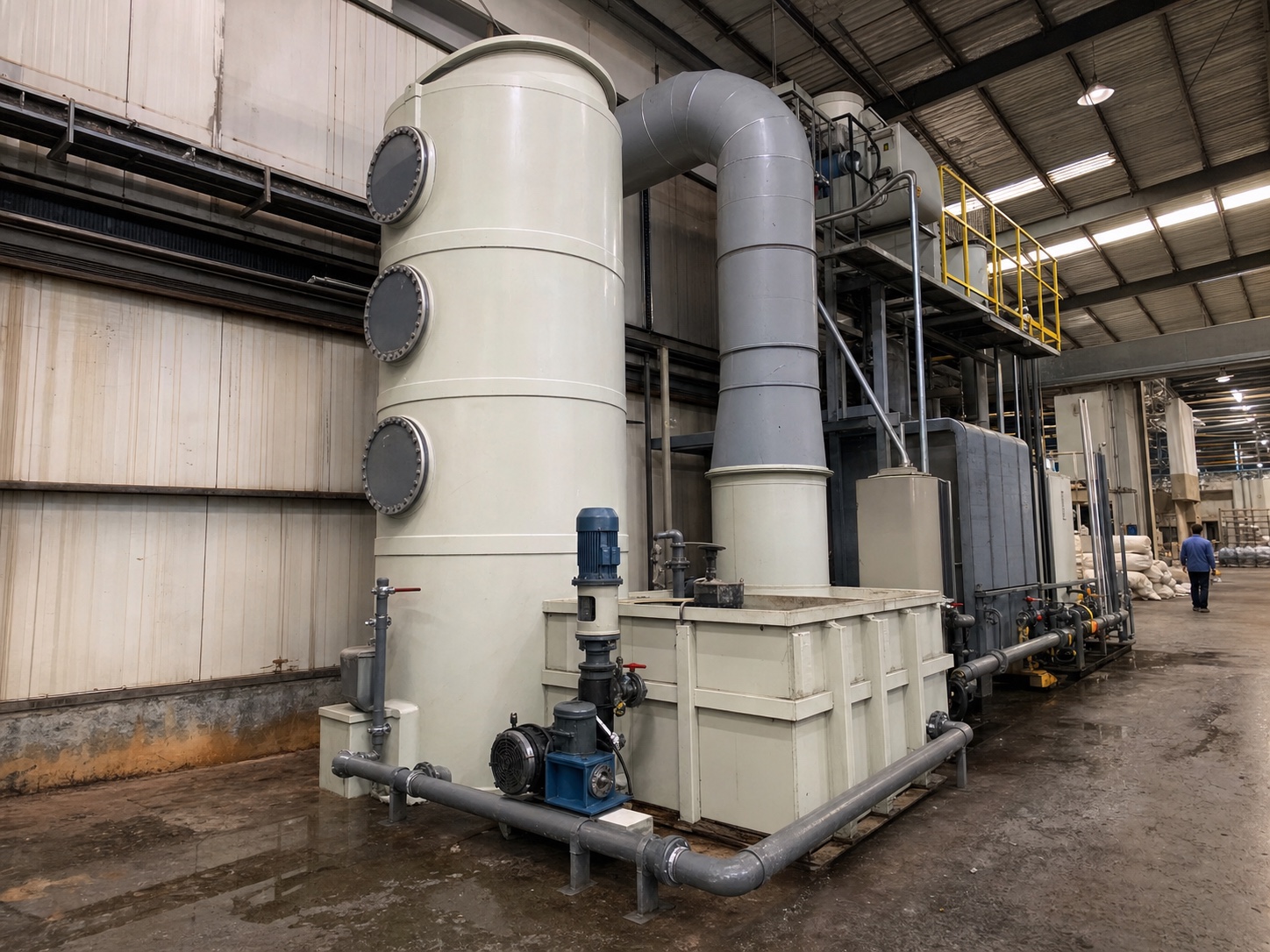
A PP scrubber spray header and mist-eliminator RFQ should define the gas and liquid duty, spray coverage, header and nozzle arrangement, mist-eliminator type, wash system, pressure-drop limits, access, drains, materials, and acceptance evidence. Send the vendor the process basis and interface drawing before asking for a price; component names alone do not define a workable scrubber package.
Start with the gas and liquid design basis
A spray-header RFQ is only meaningful when the supplier knows what the tower must treat. Begin with normal, minimum, and maximum gas flow; inlet temperature and moisture; pollutant family and concentration range; solids, droplets, or scaling tendency; scrubbing liquid; recirculation condition; and the required outlet or operating objective.
El EPA spray-tower wet-scrubber fact sheet describes spray towers as gas-liquid contact devices whose performance depends on the pollutant, liquid chemistry, gas flow, and tower design. Use that as process context, not as a generic guarantee of removal efficiency. The RFQ should state the design basis that the responsible process engineer will use for the final calculation.
Include the operating envelope rather than a single “design flow.” A header that distributes liquid correctly at one flow may be poorly covered during turndown, while a mist eliminator that is acceptable at normal flow may become difficult to wash or drain when solids loading increases. Ask the bidder to identify assumptions and exclusions.
Define the spray header and nozzle schedule
“Spray header included” is not enough for quotation. The RFQ should identify the number of header levels, elevation of each bank, pipe size, branch arrangement, nozzle type, orientation, spray pattern, material, connection method, and removal route. If nozzle selection remains with the vendor, require the vendor to return a nozzle schedule and coverage drawing for approval.
| RFQ input | What the supplier should return | Why the detail matters |
|---|---|---|
| Liquid flow and pressure basis | Design flow per bank, operating range, pressure at the header, pump assumption, and strainer arrangement | Prevents a price from being based on an unstated pump or an unrealistic nozzle condition. |
| Nozzle selection | Type, orifice or capacity data, spray angle, material, connection, and plugging-cleanout approach | Links spray coverage to liquid quality and maintenance rather than treating nozzles as generic fittings. |
| Header arrangement | Plan and elevation, level spacing, branch layout, dead-leg control, supports, and removal path | Shows whether the bank can be installed, inspected, and removed without cutting the tower. |
| Coverage and overlap | Coverage drawing or calculation with assumptions for tower cross-section, gas direction, and liquid distribution | Lets the owner review untreated zones and local wall wetting before fabrication. |
| Connections | Flanges, unions, flexible sections, gaskets, external pipe supports, and field-joint responsibility | Separates PP tank fabrication from pump and piping installation scope. |
QEEHUA’s fabrication check is to review the removal sequence at the same time as the spray pattern. A bank that is theoretically covered but trapped behind a small access opening can create a long maintenance outage. Show access doors, lifting points, drain-down, and the largest removable component on the arrangement drawing.
Specify the mist eliminator as a complete, washable module
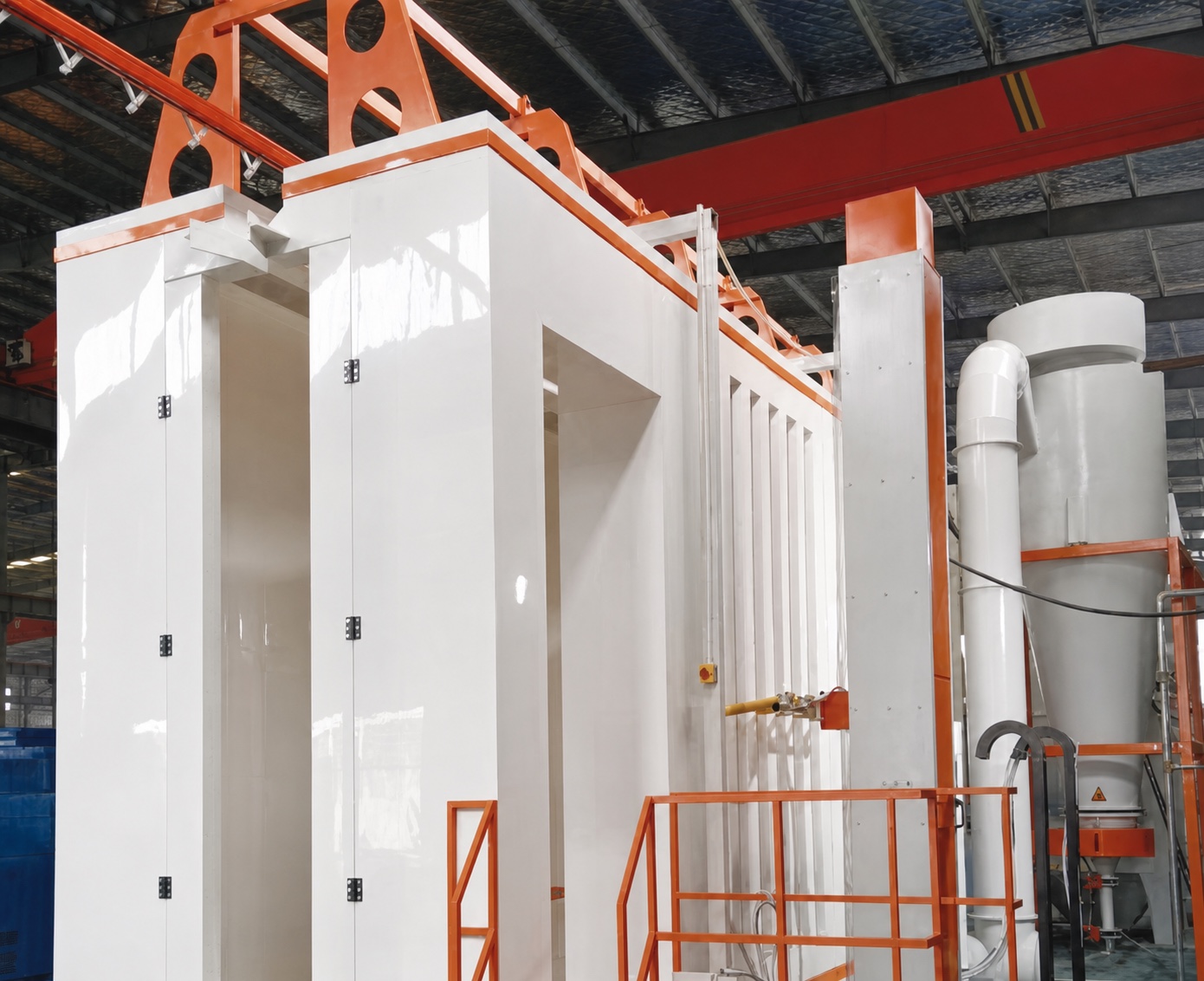
The mist eliminator should be described by function and maintainability, not only by the word “demister.” Define the selected configuration—such as mesh, chevron, vane, or another approved separator—together with the gas direction, module dimensions, support grid, hold-down or guide detail, drainage path, wash headers, and access clearance.
EPA guidance explains that wet scrubbers use mist eliminators or entrainment separators to remove droplets carried by the gas stream. It also notes that contaminant buildup can increase pressure drop and that wash arrangements, drainage, and separator geometry affect maintenance. The EPA wet-scrubber monitoring reference is useful background, but the project still needs a vendor-specific mist-eliminator selection and acceptance basis.
Include these mist-eliminator RFQ inputs:
- Gas flow range, direction, temperature, contaminant loading, and allowable pressure-drop basis.
- Separator material and any project restriction on metal, plastic, coatings, or mixed-material contact.
- Module size, lifting or pull-out route, support spacing, hold-down detail, and inspection clearance.
- Wash-nozzle location, wash medium, drain route, isolation, and cleaning frequency or trigger.
- Differential-pressure taps or other monitoring provisions, with instrument connection responsibility.
- Acceptance evidence for fit-up, drainage, cleanability, and any agreed performance test.
Coordinate PP materials, welding, and external loads
Spray headers and mist-eliminator supports can introduce concentrated reactions into a PP shell. The RFQ should state whether the header is self-supported from a steel frame, supported by PP brackets, or carried by a combination of shell penetrations and external members. Do not leave this responsibility implicit.
For each PP component, identify sheet or pipe grade, nominal thickness or schedule basis, welding-rod compatibility, flange standard, gasket boundary, and inspection requirement. QEEHUA’s practical review also checks whether a pipe support, instrument tap, or wash header is forcing the shell nozzle to carry a load that belongs on an independent support.
Keep the gas-side and liquid-side interfaces visible on the fabrication drawing. A nozzle may be chemically compatible yet still be difficult to weld, inspect, drain, or replace. For broader exhaust-material selection, link the RFQ to the PP chemical exhaust ductwork selection guide and state that final suitability depends on the actual chemical and temperature envelope.
Make access, drainage, and cleaning part of the quotation
Most scrubber RFQ gaps appear after the equipment has been installed. Ask the supplier to show how an operator will reach the spray header, remove a nozzle, wash the mist eliminator, inspect the support grid, and drain the tower without standing in an unsafe or contaminated position.
| Maintenance question | RFQ evidence to request |
|---|---|
| Can a blocked nozzle be reached? | Access-door size, removal route, isolation point, spare-nozzle strategy, and cleanout instruction. |
| Can the mist eliminator be washed? | Wash-header layout, spray direction, drain capacity, removable module detail, and pressure-drop monitoring point. |
| Can the tower be fully drained? | Low-point elevations, sump or drain connection, slope assumptions, dead-leg review, and cleaning-medium disposition. |
| Can welds and penetrations be inspected? | Inspection zones, lighting or mirror access, weld map, dimensional checks, and scope exclusions. |
| What happens after a field modification? | Controlled drawing revision, approval route, repair method, retest or inspection requirement, and handover record. |
El PP sheet wet-scrubber material and fabrication guide provides application context. Use the current RFQ to add the specific spray-header, demister, access, and interface requirements for the actual tower rather than copying a generic equipment description.
Referencia del proceso: this QEEHUA clip shows an automatic feeding system with pipes and a hopper. It is a general process-equipment fabrication reference that helps explain why pipe routing, removable interfaces, and support responsibility should be coordinated before production; it does not establish scrubber nozzle coverage or mist-eliminator performance.
Referencia de vídeo: PP Sheet Manufacturing: Automatic Feeding System with Pipes and Hopper | QEEHUA. This is a general fabrication-context reference, not a scrubber design or acceptance test.
List the documents and acceptance checks in the RFQ
Request a coordinated submittal package, not only a commercial quotation. A practical PP scrubber spray header and mist-eliminator RFQ should ask for:
- Process and equipment data sheet with gas/liquid design basis, assumptions, exclusions, and operating envelope.
- General arrangement showing spray banks, headers, nozzles, mist eliminator, wash system, access, drains, instruments, and field interfaces.
- Nozzle schedule with type, material, capacity basis, orientation, connection, and replacement method.
- Mist-eliminator data sheet with module dimensions, material, support, wash arrangement, drainage, pressure-drop basis, and monitoring points.
- PP material list, welding procedure, welding-rod identification, flange and gasket schedule, and support details.
- Inspection and test plan covering dimensions, welds, penetrations, header fit-up, demister installation, leak checks where specified, and cleaning readiness.
- Handover dossier: approved drawings, redlines, photographs, certificates, spare-parts list, maintenance instructions, and scope exclusions.
Use the broader PP sheet selection, fabrication, and applications hub to keep material, fabrication, and application decisions aligned. A clear responsibility matrix should identify what QEEHUA supplies, what the scrubber system vendor supplies, and what the installer must complete in the field.
Common RFQ mistakes that create rework
- “Complete spray system” with no nozzle schedule: the quotation cannot be compared on a common basis.
- Mist eliminator named without a wash or drain plan: scaling and pressure-drop problems are discovered only after commissioning.
- Header loads left on PP nozzles: external pipe supports and thermal movement were never assigned.
- Access treated as an afterthought: a removable module or blocked nozzle cannot be serviced through the finished opening.
- One flow number used for every condition: turndown, startup, upset, and liquid-quality assumptions are not visible.
- Scope boundaries omitted: the PP fabricator, pump vendor, steel supplier, and installer each assume another party owns the interface.
A complete RFQ does not by itself guarantee emission compliance or scrubber performance. Those outcomes depend on the process design, pollutant chemistry, operating controls, approved calculations, installation, and commissioning evidence.
Preguntas frecuentes
Should the spray header be included in the PP scrubber tank quotation?
It should be identified as a separate scope item even when supplied with the tank. State header material, nozzle schedule, supports, access, drains, connections, and responsibility for pump and field piping so the quotation boundary is unambiguous.
What information is needed to select a mist eliminator?
Provide gas flow range, direction, temperature, droplet or solids loading, liquid chemistry, allowable pressure drop, wash medium, drainage arrangement, access requirement, and the material or corrosion restrictions. The supplier should return the selected configuration and assumptions for approval.
Can PP be used for spray headers and mist-eliminator supports?
PP may be a candidate for wetted or fabricated parts when the chemical, temperature, load, and fabrication requirements are suitable. Final selection must consider support reactions, thermal movement, cleaning, fire or temperature limits, welding procedure, and project-specific acceptance; do not assume every header or support should be PP.
What should be tested before a scrubber package is handed over?
At minimum, verify dimensions, welds, penetrations, header fit-up, nozzle orientation, mist-eliminator seating, wash and drain paths, access, instruments, and documented scope exclusions. Add leak, flow, pressure-drop, or performance checks only when they are defined by the approved project test plan.
Send the process data sheet, tower drawing, spray-header concept, mist-eliminator requirement, and handover expectations through the Página de contacto de QEEHUA. We can review the PP material and fabricated details before quotation or fabrication.