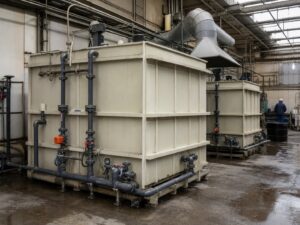
A PP chemical tank nozzle RFQ should define the service liquid, connection function, nozzle schedule, flange standard, gasket and bolting assumptions, orientation, loads, welding scope, inspection records, and site responsibility. These inputs let a fabricator quote the interface without guessing where the tank, piping, valve, and installation boundaries meet.
For the wider material-selection and fabrication context, use the PP sheet selection and fabrication guide; this article narrows that guidance to the nozzle and flange interface information needed before quotation.
Start with the connection function and chemical duty
A nozzle is not just a hole in a tank wall. It is the defined boundary through which liquid enters, leaves, overflows, drains, samples, vents, or connects to an instrument. The same nominal size can require a different detail when the service changes from a bottom drain to a pump suction, a mixer connection, or a sampling point.
List the liquid or mixture, concentration range, normal and maximum temperature, cleaning chemical, exposure time, and any solids or crystallization risk. ISO 15494 describes PP pipes, fittings, valves, and joints for industrial applications and emphasizes that components must withstand the expected mechanical, thermal, and chemical demands; use it as a design reference, not as a project-specific approval or QEEHUA certification.
QEEHUA’s chemical-resistance review is organized around the actual medium and temperature checkpoints rather than a broad label such as “acid service.” Include the concentration and temperature for each nozzle service, including cleaning and upset conditions. A chemical-resistance entry is not automatically a welding or thermal-processing approval, so any processing caution in the project material record should be reviewed before the interface drawing is released.
For a broader process-duty review, link the RFQ to the PP tank RFQ checklist. This article narrows that work to the connection boundary, where missing information often becomes a fabrication clarification or an installation change.
Build a PP chemical tank nozzle RFQ schedule before asking for a price
Attach one nozzle schedule to the controlled tank drawing. Avoid describing connections only in prose because terms such as outlet, drain, vent, and overflow can be interpreted differently by the tank, piping, and instrumentation teams.
| Nozzle field | What the RFQ should state | Por qué es importante |
|---|---|---|
| Tag and service | Unique tag, inlet/outlet/drain/overflow/vent/sample/instrument function, and connected line number | Prevents two teams from assigning different functions to the same opening. |
| Nominal size and connection | Pipe outside diameter or nominal bore, flange or stub-end detail, and the governing project standard | Nominal size alone does not define the mating face, drilling, or transition piece. |
| Location and orientation | Tank datum, elevation, clock position, centerline, internal projection, and external projection | Controls drainability, valve access, pipe routing, and interference with covers or stiffeners. |
| Service condition | Liquid, concentration, temperature, flow direction, normal level, maximum level, and cleaning condition | Supports compatibility and gasket review instead of a generic chemical-service assumption. |
| Loads and restraint | Connected pipe weight, valve or pump load, thermal movement, support point, and allowable site restraint | Tank-wall penetrations should not be treated as if they carry an unreviewed external piping load. |
| Scope and records | Supplier-furnished part, companion flange, gasket, bolts, valve, field weld, inspection point, and required records | Defines the handoff between tank fabrication and installation. |
For each nozzle, add a small detail or reference drawing rather than relying on a catalogue name. If the mating flange, gasket, valve, or support is supplied by another contractor, mark that boundary directly in the schedule. The PP chemical tank nozzle RFQ schedule should make those open responsibilities visible before the quotation is compared.
Define the PP flange and gasket interface
A flange RFQ should name the face arrangement, drilling standard, bolt circle or hole pattern, nominal size, companion material, gasket type, and whether the joint is intended to be dismantled. Do not assume that a metal piping standard can be transferred to a PP flange without checking the actual component and assembly method.
The Plastics Pipe Institute’s TN-71 flange and flange-adapter guidance discusses PP flanged connections, gasket selection, bolt assembly, and transitions to other materials. Its piping guidance is useful for the connection review, but it does not design a fabricated PP tank wall or approve a project nozzle.
- Flange face: state flat-face, stub-end, backing-ring, or another project-defined arrangement.
- Companion part: identify the mating pipe, valve, pump, flexible connector, or metal flange and its material.
- Gasket: name the proposed material or require the supplier to recommend one for the actual liquid and temperature.
- Bolting: state bolt material, washer or backing-ring assumptions, tightening procedure, and whether these are supplied.
- Assembly condition: note alignment, access for tightening, dismantling frequency, and whether the joint is exposed to vibration or thermal movement.
ASTM F3722-24 covers heat-fusion joining practices for PP pipe and fittings, including socket, butt, sidewall, and electrofusion methods. It also states that the pipe and fittings should be confirmed as compatible with the procedure. Use that limitation when requesting a welding or fusion record; do not present a piping-joint standard as a complete tank-fabrication specification.
Show geometry, access, and internal clearances
The RFQ drawing should show the tank datum, nozzle centerline, projection length, internal clearance, external clearance, and nearby stiffeners or baffles. Include the direction of removal for valves and the space needed to install a gasket or backing ring.
Bottom drains need a clear path to the low point and enough access for isolation and cleaning. Side nozzles need a defined elevation relative to the working and maximum liquid levels. Vent and overflow connections need an identified discharge route and a clear statement of whether the tank is intended to operate open, vented, or under a project-specific pressure condition. Do not infer pressure-vessel design from an RFQ checklist.
El PP chemical tank shop-drawing review should follow the RFQ. Use the same drawing number and revision across the nozzle schedule, piping interface sketch, SDS package, and approval comments.
Why material evidence belongs in the interface review: this QEEHUA video shows a PP sheet tensile-strength test. It is useful context when an EPC asks for material records alongside a nozzle schedule, but it does not approve a nozzle dimension, flange assembly, weld procedure, or chemical service.
Referencia de vídeo: PP Sheet Tensile Strength Test | QEEHUA Lab Quality Verification. It provides general PP material-evidence context for a quotation package; confirm the approved tank drawing, connection geometry, welding method, and project acceptance requirements separately.
Keep the video separate from the figures and continue the RFQ review in text. A fabricator should be able to identify the controlled geometry, open assumptions, and responsibility for every mating component before cutting begins.
Separate tank fabrication from site piping responsibility
A clear RFQ states what QEEHUA is expected to fabricate and what the piping or installation contractor will complete. This is especially important when a nozzle is supplied with a companion flange but the valve, gasket, bolts, support, or field joint are supplied by others.
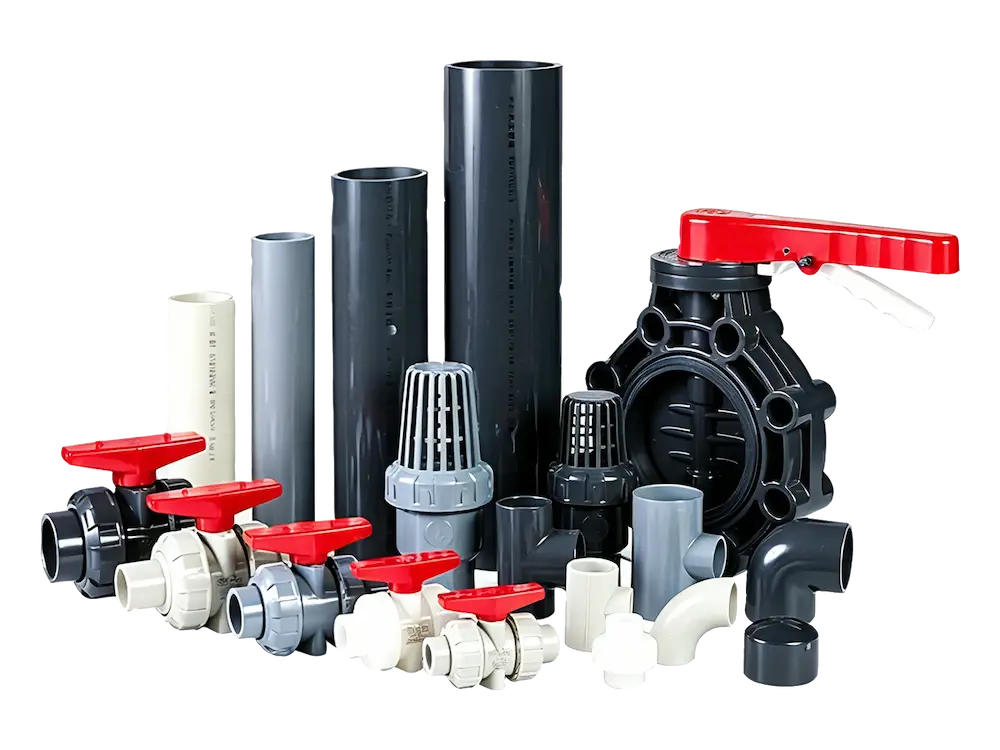
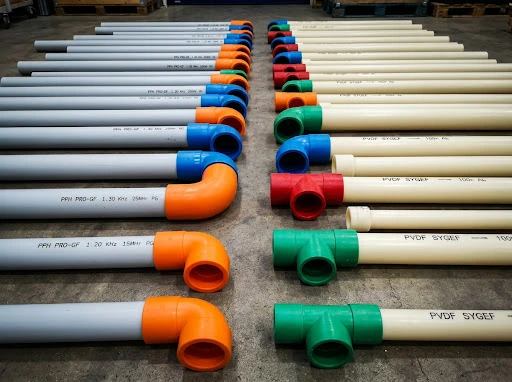
If the package includes PP fittings, name the exact scope boundary for couplings, unions, elbows, tees, reducers, adapters, and companion pieces. QEEHUA’s product information identifies these as industrial fitting categories, but the RFQ still needs to say which items are furnished, which are field-installed, and which connection method is required.
- Mark the tank-wall opening, nozzle neck, flange or stub-end, and any reinforcement as supplier scope or buyer scope.
- Identify the mating pipe outside diameter, material, connection standard, and field-welding or bolting responsibility.
- State whether the tank leaves the shop with temporary protection, a final gasket, loose backing rings, or no site-installed accessories.
- List the inspection hold point for nozzle alignment, weld appearance, dimensional checks, and any specified leak or functional test.
- Record transport limits and site-access constraints that could affect a preassembled valve or long external nozzle.
Request a quotation that exposes assumptions
A useful quotation should return more than a total price. Ask for a marked-up scope, drawing reference, proposed material, connection schedule, exclusions, and open questions. A PP chemical tank nozzle RFQ should let the buyer compare offers on the same design basis.
| Quotation response | Minimum useful evidence |
|---|---|
| Connection scope | Tagged nozzle list, flange or pipe interface, companion parts, and supplier/site boundary. |
| Fabrication basis | Drawing revision, PP sheet and welding-rod identification, joint approach, access assumptions, and support notes. |
| Inspection package | Dimensional checks, visual or specified weld inspection, material records, and any agreed leak or functional test. |
| Commercial exclusions | Valves, gaskets, bolts, pipe supports, field joints, insulation, lifting, installation, and commissioning responsibilities. |
| Open items | Unconfirmed chemistry, temperature, nozzle loads, flange standard, gasket selection, or approval authority. |
Common PP tank nozzle and flange RFQ mistakes
- Capacity-only request: tank volume does not define nozzle location, liquid head, connected loads, or maintenance clearance.
- Unspecified mating part: A standard flange description is incomplete without the face, drilling, companion material, gasket, and project standard.
- Missing chemical and cleaning duty: gasket and wetted-interface decisions need the actual service conditions.
- No responsibility boundary: unassigned valves, bolts, supports, or field welds create quotation gaps and installation disputes.
- Old drawing revision: a nozzle schedule should carry the same revision control as the tank and piping drawings.
Preguntas frecuentes
What is the most important field in a PP chemical tank nozzle RFQ?
The most important field is the connection function tied to the actual service duty. Identify whether the nozzle is an inlet, outlet, drain, overflow, vent, sample, or instrument connection, then add the liquid, temperature, level, location, and mating component.
Should a PP flange RFQ include the gasket and bolts?
Yes. State whether the gasket, bolts, washers, backing ring, and companion flange are included or supplied by others. The service liquid, temperature, alignment, and dismantling needs should be reviewed before the final gasket and assembly method are accepted.
Can I specify a nozzle from nominal pipe size alone?
No. Nominal size does not define the flange face, drilling, projection, orientation, internal clearance, connected load, or installation responsibility. A controlled nozzle schedule and interface drawing are needed before fabrication.
Does a PP piping standard approve a fabricated chemical tank nozzle?
No. A piping standard can provide relevant component or joining guidance, but the tank wall, nozzle reinforcement, chemical duty, supports, welding, inspection, and project acceptance still require a project-specific engineering review.
Send the controlled tank drawing, nozzle schedule, service liquid and SDS, temperature range, pipe and flange standards, connected loads, gasket assumptions, and required inspection records through the Página de contacto de QEEHUA. QEEHUA can review the fabrication and quotation scope; final suitability remains subject to the approved project design.